


2026 rate check
What does SEO cost in Australia?
The honest answer is a range, because SEO is sold three different ways. Here's what each band buys, where the cheap end bites, and what a sensible spend looks like for a local trade business.
How is SEO actually priced?
Across the published 2026 Australian pricing guides we reviewed, SEO runs $150 to $350 an hour, $500 to $5,000-plus a month on retainer, and $2,000 to $10,000-plus for one-off projects. It is also sold as a fixed package, which is a menu price rather than a market rate. Two of the guides we reviewed separately call $1,500 to $3,000 a month the "sweet spot" for small businesses.
- By the hour $150-$350/hr
- Monthly retainer $500-$5k+/mo
- One-off project $2k-$10k+
- The sweet spot $1.5k-$3k/mo
The spread depends on how you buy it.
| How you pay | Published range | What it covers | Makes sense when |
|---|---|---|---|
| By the hour | $150 to $350 an hour | Consulting: an audit, a second opinion on another provider's work, answers to specific technical questions. Three of the guides we reviewed publish overlapping bands, and the rates page we reviewed stretches the floor to $50. | You need a diagnosis or advice, not a program of work. |
| Monthly retainer | $500 to $5,000+ a month | The standard way SEO is bought. A provider works on your site every month: pages, content, links, your Google listing, a report. The tiers are broken down in the next section. | You want rankings moved, then held, in a market someone else is also working on. |
| One-off project | $2,000 to $10,000+ | A defined job with an end date. Published ranges: site audits $2,000 to $5,000, site moves $3,000 to $10,000-plus, content audits $2,000 to $6,000. | Something specific is broken, or you're changing platforms. |
| Fixed package | $1,250 to $6,600+ a month | A retainer sold off a menu: fixed scope, published price, tiers keyed to a keyword count or the size of your site. That span covers the three seller menus we compared, and it isn't the market floor. Budget providers publish cheaper. | You want a known price and a known scope before you commit. |
What clients actually average by city, per the published 2026 rates page we reviewed (plus GST):
- Brisbane $4,699/mo
- Melbourne $4,062/mo
- Sydney $3,710/mo
- Adelaide $2,420/mo
These averages come from that one page's own client list, so treat them as indicative rather than a census. The same page puts the most common national spend at $2,000 to $5,000 a month, a step above the guides' sweet spot. The overlap, roughly $2,000 to $3,000, is a fair working centre.
Comparing fixed monthly bundles rather than open retainers? The six line items every Australian package is built from, and what to check on each one, are further down this page: what's actually in an SEO package.
What does each price band buy?
Hours, mostly. Divide any retainer by the going hourly rate and you get the number that matters: how much attention your site gets each month. Call it $200 an hour, a mid-range published rate: an $800 retainer buys four hours, a $3,000 retainer buys fifteen.
-
Entry
$500-$1,000 a month
- Two and a half to five hours a month at $200 an hour
- Foundation work: page titles, site structure, your Google listing set up properly
- Enough for a small site in a quiet market
- One of the guides we reviewed starts its tiers here; another's averages begin at $1,500
-
Growth
$1,500-$3,000 a month
- Seven to fifteen hours a month, enough for steady output
- New pages and content, link work, the listing looked after, reporting against rankings
- Where two of the three guides we reviewed point most small businesses
- The dearest of the guides we reviewed sells this same band as basics for quiet niches, so rates track the seller as much as the work
-
Authority
$3,500-$5,000+ a month
- Seventeen to twenty-five hours a month, and up
- One of the guides we reviewed calls $3,500 to $5,000 the best-return band for small-to-medium businesses
- Above $5,000: competitive niches, multiple locations, national terms
- Full-service campaigns at one of the guides we reviewed start at $5,500
Hours are what the money buys. What those hours get spent on is the next question, and the sellers who publish a fixed package answer it in line items.
What's actually in an SEO package?
A package is a retainer sold off a menu: a fixed monthly bundle at a published price. Australian sellers scope the tiers by keyword count, page count or deliverable volume, but the contents come from the same six categories: a technical audit, on-page optimisation, content, link building, work on your Google listing, and a monthly report.
| The line item | What it is | What to check |
|---|---|---|
| Technical audit | A crawl of your site for anything stopping Google reading it: broken links, slow pages, missing titles. | The audit should turn into a fix list in month one, and the next report should show the fixes done. |
| On-page optimisation | Titles, headings and copy tuned to real searches ("hot water repairs {suburb}"), not just your business name. | Ask which pages and which searches. Either a list exists or it doesn't. |
| Content | New pages or posts so Google has something to rank for each service and area you want work from. | For a local business, service and suburb pages earn more than generic blog posts. |
| Link building | Other sites linking to yours, which Google reads as a signal of trust. | Where links come from matters more than how many. Ask for three recent examples. |
| Your Google listing | Setting up and managing your Google Business Profile, the map listing people see when they search nearby. | For a service-area business, a lot of the value lives here. If it's missing, the package wasn't built for you. |
| Monthly report | What was done, what moved and what's planned. | It should connect the month's work to rankings and enquiries. Traffic graphs alone answer the wrong question. |
Moving up a tier usually changes the volume, not the categories: more keywords tracked, more pages written, more links built. The menus scope their tiers by keyword count (7 to 10 at entry, 20-plus at the top) or by the size of your site (under 20 pages, 20 to 40, then 40-plus).
A menu price is not a market rate
This is where the numbers stop agreeing, so it is worth being exact about which is which. The bands further up this page are what the pricing guides say the work costs. A package price is a different animal: it is what one seller has decided to charge for one fixed scope. The three Australian package menus we compared publish $1,250 to $6,600 or more a month, often quoted excluding GST.
That span belongs to those three menus. It is not a market floor, and the budget providers in the next section publish packages well under it. Two sellers can price the same six line items hundreds of dollars apart, and the gap tells you about their business rather than about yours. So compare a menu against the guide bands, not against the seller standing next to it.
One of the guides we reviewed runs a fourth band above these, an enterprise tier reaching $15,000-plus a month. That is national and eCommerce territory. A local trade business is not in that contest.
Below $500 a month sits the band the guides only write warnings about. It gets its own section.
Why does cheap SEO end up costing more?
Because the hours don't exist at that price. Once a provider covers its own costs, a sub-$500 retainer buys an hour or two a month, so the volume gets faked: canned reports, spun content, bulk links. The guides that document this tier say the cheapest provider often proves the dearest, through poor results or penalties.
In fairness to the cheap end, not every business needs a campaign. If you trade in a quiet market and the basics just need tidying, a few hundred dollars of hourly help, or no retainer at all, can be the right answer. The trap is expecting a $400 spend to compete with a rival spending $2,000 on the same searches.
The $99-a-month operators you get cold emails about are also shy in daylight: we went looking and couldn't find one publishing a price on an Australian pricing page. The cheapest published packages we verified were $695 plus GST and $799 a month, and those providers brand themselves as the budget option. The sub-$300 offers live in cold outreach and freelance marketplaces instead, which is its own signal.
What the published budget packages sell is volume: $799 a month buys 25 keywords and two 350-word articles, $1,199 buys 50 keywords, and a "results guarantee" is available as a paid add-on. Keyword counts price the inputs. Nothing in a count of 25 tells you whether a single one is a search your clients actually make.
On the damage question, the two biggest guides we reviewed converge: suspiciously low prices in a competitive market usually mean "automated link schemes, spun content or offshored delivery", and low-cost link building "rarely builds authority". Both guides sell dearer retainers, so weigh the source. The mechanism still stands, though: the shortcuts that make ultra-cheap SEO deliverable are exactly what both guides blame for the penalties, and undoing that damage is billable work.
What should you ask before you sign?
Five questions will tell you more than any tier table. Put them to every seller you are comparing and listen for specifics about your business: named pages, named link sources, a report you could read yourself. A vague answer on any of the five is your cue to keep looking.
-
What would you do for my business in the first 90 days?
The answer should name your site's actual gaps, your area and the searches you want. If it could be pasted to any business unchanged, it will be.
-
Where do your links come from?
Ask for three examples built for a current client. Real sites you could read and recognise pass the test; a spreadsheet of directories and offshore blogs doesn't.
-
Who does the work each month?
An overseas team isn't a problem on its own. A seller who can't tell you who writes your pages and builds your links is reselling a package they've never opened.
-
Can I see a real monthly report?
A redacted client report tells you more than the sales deck. Look for work tied to rankings and enquiries, plus next month's plan in plain English.
-
What's the minimum term, and what do I keep?
Fair answers: a few months to judge the work, and everything (site, content, your Google listing) stays in your name. Get both in writing before money moves.
Two answers should stop you. The first is a lock-in longer than the proof. SEO takes months, so a few months of commitment is fair, but a 12-month minimum with no review point along the way is not. Ask what happens at month three if nothing has moved, and get the answer in writing. The second is a quote that never mentions your Google listing: if you serve an area and the map listing is missing from the line items, the package was scoped for an online store, not for you.
What does SEO cost for a trade business?
Often less than the city averages above. One of the guides we reviewed bands entry SEO for trades in smaller markets at $800 to $1,500 a month, which it costs out at roughly five to eight hours of work. The reason is the size of the contest: a trade business competes with the handful of businesses serving its suburbs.
Those hours also buy assets, not airtime. A page built for one service in one suburb ("blocked drains in Springwood", say) is up against a handful of local sites, and once it ranks it answers that search every month with no per-click bill attached. Ads can put you in the same spot tomorrow, but the meter runs on every click.
That's also why local spend beats national spend for a service-area business. National terms live up in the $5,000-plus authority tiers; the same budget pointed at your own patch covers service pages, suburb pages and your Google listing. The rates page we reviewed lists 2026 local campaigns anywhere between $880 and $12,125 plus GST a month, which mostly proves that "local" stretches from one suburb to a whole city.
~10 new clients a month What the spend can turn into: Quick Mick's Plumbing in the Blue Mountains ranks on page one and picks up around 10 new clients a month, with no ad spend. Read the case study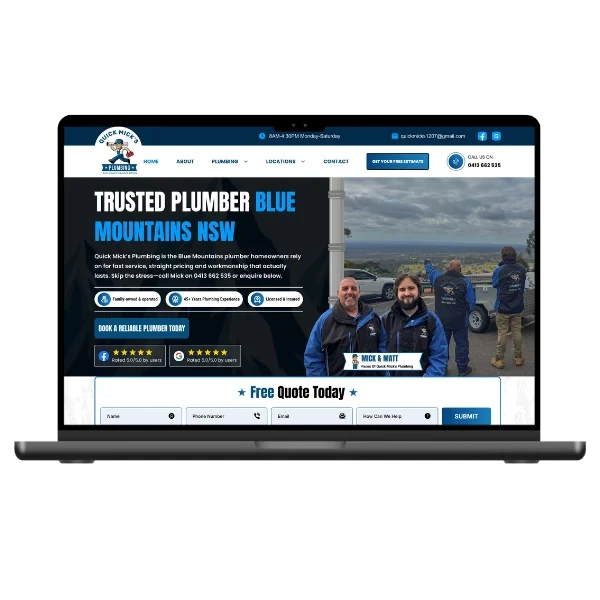
If you're weighing this up for your own trade business, the service side of the picture lives on our SEO for tradies page. And check the foundation before you buy rankings: every ranking points people at your website, so if the site itself is the weak link, start with what a tradie website costs.
How does KINGTRADIE price SEO?
We do SEO for Australian trade businesses, and we don't publish a price list. Every job is scoped on a strategy call first: what you rank for today, which jobs you want more of, and how contested your service area is.
The quote comes back fixed, and everything the work builds, the pages, the content, the listing, stays in your name. No lock-in.
Pricing questions?
Short answers before the quotes come in.
How much does SEO cost per month in Australia?
The published 2026 guides we reviewed band monthly retainers from $500 entry work to $5,000-plus authority campaigns, and two of them call $1,500 to $3,000 the small-business sweet spot. For a local yardstick, the 2026 rates page we reviewed puts city averages at $2,420 a month in Adelaide, $3,710 in Sydney, $4,062 in Melbourne and $4,699 in Brisbane.
What is included in an SEO package?
Six categories cover almost every Australian package: a technical audit, on-page optimisation, content, link building, work on your Google listing and a monthly report. Moving up a tier usually buys more volume of each, scoped by keyword or page count, rather than adding new categories. Ask for the line items in writing.
Why does SEO cost so much?
Because you're paying for skilled hours every month. Australian guides publish rates of $150 to $350 an hour, so even a $1,000 retainer buys about five hours: pages written, links earned, your Google listing worked on, results reported. Cut the price and it's the hours that quietly disappear.
How long before SEO pays for itself?
Months rather than weeks, and be wary of anyone promising a date. The useful maths is your own: divide the monthly spend by an average job's value to see how many extra jobs cover it. The trade-off for the wait is that a ranking, once won, keeps producing without a per-lead cost.
Is cheap SEO worth it?
Occasionally, in a quiet market where tidy basics are all you need. The maths is the problem elsewhere: one of the 2026 guides we reviewed shows $400 a month buying one to two hours of attention, and the sub-$500 tier is where the industry reports spun content and automated link schemes, which can drag rankings backwards.
What should a monthly SEO report show?
Four things: the work done that month (pages, content, links, listing updates), rankings for the searches that bring you work, enquiries or calls from the website, and what's planned next month. If a report can't connect the month's work to enquiries, you're reading an activity log, not a result.
How much should a small business spend on SEO?
Match the spend to your competition, not to a tier chart. In a quiet local market, the $800 to $1,500 trades band from one of the guides we reviewed buys enough hours to matter. In a contested one, remember what you're really buying: if a close competitor spends double, they get double the hours on the same contest.
Where these numbers come from
- Hourly, retainer and project ranges: three Australian agencies' published 2026 SEO pricing guides, retrieved July 2026
- The enterprise-tier footnote: a fourth Australian agency's published 2026 SEO pricing guide, retrieved July 2026
- City averages, the $2,000 to $5,000 common range, the local-campaign spread and the $50 hourly floor: one Australian agency's published 2026 rates page, retrieved July 2026
- Fixed-package prices, tier scoping and deliverables: three Australian SEO sellers' published package pages, retrieved July 2026
- Budget package pricing: two Australian providers' published packages pages, retrieved July 2026
- Quick Mick's figures: our own published case study, results as reported by the client
Figures retrieved July 2026. Every unnamed source above is an agency or provider publishing its own rates, so floors carry seller bias. Check current pages before you rely on a number.
Quotes on the table?
Hold each one against the bands on this page and ask what the monthly hours actually go on. If you'd rather start with your own numbers, book a call: we'll look at your area, tell you what's winnable, and put a number on it. No obligation.
Book a call